NOTICE
We use cookies to improve the user experience and analyze its performance.
Choosing the best Silicon Carbide Balls supplier requires more than comparing catalog prices. A reliable supplier must demonstrate stable material quality, accurate sizing, and consistent production records. These details matter when balls operate inside grinding mills, ceramic equipment, pumps, or high-temperature processing systems.
Professor Yutai Katoh, a recognized silicon carbide materials researcher, has emphasized, “Performance depends on processing, microstructure, and service conditions.” This principle also applies to Silicon Carbide Balls. A strong supplier should explain its forming method, sintering process, hardness range, density, and chemical composition. Buyers should request inspection reports, sample measurements, and evidence of batch-to-batch consistency.
Look closely at the details.
The best supplier is not always the cheapest. A low quotation may hide irregular diameters, excessive porosity, weak packaging, or limited technical support. During practical evaluation, place sample balls on a clean steel tray and check their surface finish, roundness, and visible defects. Ask how the supplier controls crushing strength and wear resistance under real operating conditions.
Experience also matters. Suppliers serving demanding industries usually understand delivery planning, protective packaging, and replacement requirements. However, no supplier is perfect. Specifications may still need adjustment after field testing. A careful buyer should compare several manufacturers, verify certifications independently, and confirm whether technical claims match laboratory results. This approach supports a more reliable decision when identifying the best Silicon Carbide Balls supplier for performance, durability, and long-term operating value.
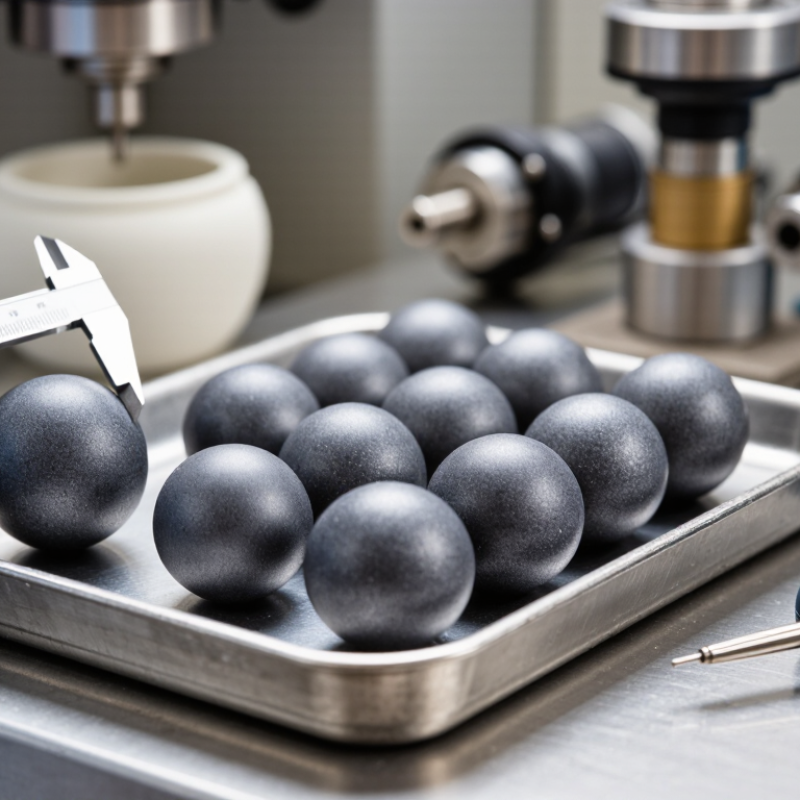
The better question is not simply “China best silicon carbide balls supplier?” It is whether the balls match the working conditions. Silicon carbide balls are dense ceramic spheres made from sintered or reaction-bonded SiC. They offer high hardness, strong thermal stability, and good resistance to many corrosive chemicals. Their surface stays stable inside hot reactors, filtration systems, grinding equipment, and high-wear assemblies. They are not universal, however.
Performance depends on purity, density, diameter tolerance, porosity, and bonding method. A 10 mm ball used in a catalyst bed needs different properties from a grinding ball. Engineers should check compressive strength, thermal-shock resistance, and batch consistency. A polished surface can reduce friction, while controlled porosity may improve flow distribution. Small defects still matter. One cracked ball can disturb a packed bed.
The International Energy Agency reported nearly 14 million electric-car sales in 2023, compared with about 2.5 million in 2019. This growth supports wider demand for silicon-carbide power components, but it does not directly measure SiC ball demand. The U.S. Geological Survey’s Mineral Commodity Summaries 2024 identifies silicon carbide as an important manufactured industrial material. Supplier evaluation should therefore include inspection records, sampling plans, and technical traceability. Price alone is a weak filter. Tensile data is also insufficient for ceramic spheres. Practical testing under real temperature, load, and chemical exposure remains necessary.

High-quality silicon carbide balls begin with controlled composition, not just appearance. Silicon carbide offers high hardness, thermal stability, and resistance to many corrosive media. These properties support grinding, filtration, furnace support, and specialized chemical processing. A dense ball should have a consistent surface, without visible cracks, deep pits, or rough edges. Small flaws matter. They can become failure points during repeated impact or thermal cycling.
Dimensional accuracy also affects performance. Balls with tight diameter tolerances create more predictable packing and movement inside equipment. Low porosity usually improves strength and limits unwanted liquid absorption. However, “low porosity” needs test data, not a sales phrase. Request density, hardness, chemical composition, crush strength, and size distribution. Batch records and independent inspection results make those claims more reliable. For a China-based supplier, traceability and export documentation also deserve careful review. Compare samples from several cartons. One perfect sample proves very little.
The correct grade depends on temperature, load, media chemistry, and contact conditions. A wear-resistant ball may not tolerate sudden temperature changes. Test a small batch before continuous production. Measure wear, breakage, and dimensional changes after use. Laboratory values cannot predict every installation. That is an uncomfortable limitation. Reliable technical support should discuss these uncertainties openly. Suppliers should explain the firing process, inspection method, operating limits, and expected service behavior clearly. Honest technical discussion often reveals more than an attractive quotation.
Silicon carbide balls begin as high-purity powder, not finished spheres. Manufacturers blend, granulate, and press the powder into rough blanks. Cold isostatic pressing improves density across each blank. The parts then undergo high-temperature sintering, often above 2,000°C in controlled atmospheres. Diamond grinding removes surface irregularities. Final lapping can produce a smooth, dark surface with tightly controlled roundness.
According to Grand View Research, the global silicon carbide market was valued at approximately USD 4 billion in 2023. Its report also forecasts strong growth through 2030, driven by power electronics, pumps, and harsh-environment equipment. That growth increases demand for consistent ceramic components. However, market growth does not prove product quality. A reliable supplier should provide batch numbers, material composition, density, and dimensional records.
Testing usually starts with visual inspection and precise measurement of diameter, roundness, and surface roughness. Density testing can reveal hidden pores or uneven sintering. Hardness and fracture-strength tests help assess resistance to wear and sudden loading. Microscopic examination may expose grinding damage near the surface. Independent laboratories can verify critical results through documented methods. ISO and ASTM procedures are useful references, although silicon carbide ball specifications may require customized protocols. No test is perfect. I would question any report without sample size, equipment details, and acceptance limits. A small sample can look excellent while an entire batch remains inconsistent.
China Best Silicon Carbide Balls Supplier?
How to Evaluate a Reliable Silicon Carbide Ball Supplier
Choosing a reliable silicon carbide ball supplier requires more than comparing prices. Start by checking material data, production experience, and quality controls. Ask for evidence. A serious supplier should provide purity, density, hardness, diameter tolerance, and porosity data. These figures must match your application, whether it involves grinding, heat treatment, or chemical processing.
Request representative samples before placing a large order. Samples matter. Measure their diameter with calibrated equipment and inspect the surface for cracks, chips, or uneven glazing. Laboratory testing can verify silicon carbide content and bulk density. A certificate of analysis is useful, but independent confirmation is stronger. Do not rely on attractive photos.
Traceability also deserves attention. The supplier should identify raw material batches, inspection dates, packaging methods, and responsible personnel. Ask how rejected balls are separated from approved stock. During a factory review, observe storage conditions. Moisture, dust, and careless handling can affect product cleanliness. Export experience, clear technical communication, and stable lead times are practical reliability indicators.
A dependable supplier should explain limitations honestly. Perfect consistency is difficult, especially across large batches. That point is easy to overlook. Confirm minimum order quantities, replacement procedures, test standards, and shipping protection in writing. Some suppliers provide extensive documents but weak follow-up after payment. Regular communication and transparent corrective action reveal more than a polished brochure.
| Evaluation Dimension | Recommended Weight | Realistic Technical Reference | Evidence to Request | Reliable Supplier Indicator | Evaluation Status |
|---|---|---|---|---|---|
| Material Composition and Purity | 20% | Silicon carbide content commonly varies by grade. General industrial grades may be around 90%–99% SiC, while high-purity technical ceramic grades can exceed 99%. | Material certificate, chemical analysis report, batch number, and test method. | The supplier clearly identifies the SiC grade, free silicon, carbon, oxygen, iron, and other relevant impurities instead of using only the term “high purity.” | Critical Check |
| Bulk Density and Porosity | 12% | The theoretical density of silicon carbide is approximately 3.21 g/cm³. Actual density depends on the manufacturing process and may be lower because of open or closed porosity. | Density report, apparent porosity data, water-absorption data, and applicable test standard. | Results are reported by production batch and are linked to the exact ball size and material grade. | Verify by Batch |
| Dimensional Accuracy | 12% | Available diameters may range from small laboratory sizes to larger industrial balls. Precision tolerances must be agreed in the purchase specification; a tolerance such as ±0.05 mm may be achievable for selected precision sizes but is not universal. | Dimensional drawings, inspection records, calibrated measuring equipment, and sample measurement data. | The supplier states diameter tolerance, sampling plan, measurement method, and acceptance limits before production. | Specification Required |
| Sphericity and Surface Finish | 10% | Good sphericity supports consistent flow, wear behavior, and contact performance. Required roundness and surface roughness depend on whether the balls are used for bearings, grinding, valves, packing, or thermal applications. | Roundness or sphericity measurement, surface-finish data, microscope images, and representative samples. | The supplier provides application-specific limits rather than claiming that every product has the same precision level. | Application Dependent |
| Hardness and Wear Resistance | 12% | Silicon carbide has a Mohs hardness of approximately 9–9.5 and is recognized for high abrasion resistance. Actual wear performance depends on porosity, bonding phase, load, speed, and operating medium. | Hardness test report, abrasion or wear test results, test conditions, and sample identification. | Comparative wear data is supplied under defined test conditions instead of relying only on general material descriptions. | Performance Check |
| Temperature and Chemical Compatibility | 10% | Silicon carbide retains useful strength at elevated temperatures and generally resists many acids and alkalis. Oxidizing environments, molten metals, fluorine-containing chemicals, and aggressive process media require specific compatibility review. | Recommended operating limits, atmosphere data, corrosion test results, and chemical compatibility statement. | The supplier distinguishes between inert, vacuum, oxidizing, reducing, and chemically aggressive service conditions. | Service Specific |
| Manufacturing Process and Consistency | 10% | Reaction-bonded, pressureless-sintered, recrystallized, and hot-pressed SiC can have different density, strength, purity, and dimensional behavior. | Process description, production flow, quality-control plan, furnace records, and batch traceability procedure. | The supplier explains the process that matches the requested performance and can maintain consistent results across repeat orders. | Traceability Needed |
| Quality Management and Inspection | 8% | A documented quality system should cover incoming materials, in-process controls, final inspection, nonconforming products, and corrective actions. | Quality certificate, inspection checklist, calibration records, sample inspection report, and corrective-action records where applicable. | Documents are current, product-specific, and supported by measurable inspection results rather than generic certificates only. | Audit Recommended |
| Packaging and Export Protection | 3% | Ceramic balls can chip or fracture during transport if they are loose-packed or exposed to impact. Moisture protection may also be needed for certain packaging materials and applications. | Packaging photos, packing specification, pallet details, drop-protection method, and shipping documentation. | Packaging is adapted to ball size, quantity, fragility, transport distance, and destination requirements. | Check Before Shipment |
| Sampling, Trial Order, and Technical Support | 3% | A trial order should confirm dimensions, density, surface quality, chemical composition, and performance under the buyer’s actual conditions. | Pre-production sample, agreed acceptance criteria, test plan, technical datasheet, and after-sales response procedure. | The supplier accepts measurable trial criteria and provides timely technical responses without changing specifications after order confirmation. | Strongly Recommended |
Silicon carbide balls serve demanding industrial applications where hardness, thermal stability, and chemical resistance matter. Their performance depends on purity, density, surface finish, and manufacturing consistency. A reliable supplier should provide test reports, dimensional data, and traceable batch records.
In ceramic and mineral processing, these balls work as grinding media inside high-energy mills. Their low wear rate helps reduce contamination during powder production. Engineers also use them in high-temperature reactors as support media for catalysts and structured packing. SiC tolerates rapid heating better than many conventional ceramics. It remains stable in corrosive process environments.
Thermal processing is another practical field. SiC balls can support heat transfer and resist oxidation in selected furnace systems. Some plants use them in filtration or gas-cleaning equipment, but design compatibility must be checked carefully. Pore structure and operating temperature change the result. Small errors matter.
During supplier evaluation, I would request samples before approving a large shipment. Inspecting chipped edges, size variation, and crushing strength can reveal hidden problems. A lower price may reflect weaker control. That deserves reflection. Not every “high-purity” claim means the same thing. Application data, inspection records, and operating experience should guide the final choice.
Silicon carbide balls are selected for their high hardness, wear resistance, chemical stability, and high-temperature performance. The chart shows representative operating-temperature bands for common industrial applications; actual limits depend on grade, atmosphere, load, pressure, and equipment design.